

What are the restricted items/foods when entering Australia? What does the Australia incoming passenger card look like? This article provides a complete Australia entry guide, including precautions, required documents, entry procedures and a list of restricted items. It also explains common types of Australia visas and finally shares professional ETA agency services with you!
| Table of Contents: |
| I. Australia Entry Guidelines: A Summary of Entry Precautions and Required Documents (1) Be Cautious When Entering Australia! These Behaviors Must Be Avoided! (2) Essential Documents for Australia Entry II. Introduction to 3 Common Types of Australia Entry Visas: Purpose, Eligibility, and Validity at a Glance Australia Electronic Travel Authority (ETA) (Subclass 601) Australia Student Visa (Subclass 500) Australia Working Holiday Visa (Subclass 417) III. Decoding the Australia Entry Process! 3 Key Steps to Help You Pass Through Customs Smoothly Step 1: Fill Out the Australia Incoming Passenger Card Step 2: Immigration Inspection Step 3: Customs Inspection and Quarantine IV. What Items/Foods Are Allowed or Prohibited in Australia? How Much Cash Needs to Be Declared? (1) Which Foods Are Prohibited from Entering Australia? A List of Banned and Restricted Foods (2) Bonus Content! A Summary of Precautions for Entering Australia V. Applying for an Australia ETA Is Super Easy! Agency Services Let You Enjoy Australia Hassle Free! |
I. Australia Entry Guidelines: A Summary of Entry Precautions and Required Documents
(1) Be Cautious When Entering Australia! These Behaviors Must Be Avoided!
Australia customs are very strict. A single oversight may lead to violations, risking fines, deportation, or even imprisonment. To ensure smooth customs clearance, it is recommended that you carefully read the relevant regulations before departure and truthfully declare the items you carry.
Violations:
- Falsifying entry information: Providing false information on the entry declaration form, such as claiming to enter for tourism purposes but actually intending to work or reside illegally.
- Carrying prohibited items without declaration: Bringing items that are prohibited from entry without declaring them to customs.
- Failure to handle prohibited items as required: Even if you voluntarily declare prohibited items, failing to handle them in accordance with customs regulations may still be considered a violation.
- Refusing to cooperate with customs inspections: Refusing or obstructing inspections when customs officers request to check your luggage.
Even after successfully setting foot on Australia soil, you must abide by local laws and regulations. Overstaying your visa or working without permission will not only risk deportation but may also affect your chances of applying for visas in the future.
Penalties:
- Fines: For minor violations, customs will issue an on-the-spot fine of AUD 340. For serious cases, you may face high fines, up to AUD 66,000.
- Forced repatriation: Australia customs have the right to refuse entry to violating passengers and force their repatriation.
- Long-term imprisonment: Acts involving smuggling or trafficking of prohibited items may result in imprisonment for up to 10 years.
(2) Essential Documents for Australia Entry
In addition to avoiding the above violations, preparing complete entry documents is also key to smooth customs clearance. To enter Australia, you must hold the following three major documents:
Incoming Passenger Card
The incoming passenger card is the first step in communicating with Australia customs. Please fill it out carefully to ensure the information is accurate and error-free. It includes your personal details, purpose of travel, duration of stay, items carried, etc.
Valid Passport
A passport is proof of your identity. Please ensure that your passport is valid for at least 6 months and that the photo on the personal information page is clearly identifiable.
Visa
Except for Australia and New Zealand citizens, all other foreign travelers need to apply for a visa in advance to enter Australia. Australia offers a variety of visa options to meet the needs of different travelers, including the Electronic Travel Authority (ETA), Student Visa, Working Holiday Visa, etc. If you want to know the applicable groups and validity periods of each visa, keep reading!
Nexus Travel is your best choice for fast and easy Australia visa processing!
II. Introduction to 3 Common Types of Australia Entry Visas: Purpose, Eligibility and Validity at a Glance
Whether you want to visit Australia for a short time, study there long-term, or work while traveling, Australia can meet your needs. The following will introduce the most suitable visa types for different purposes.
Australia Electronic Travel Authority (ETA) (601)
ETA is a popular and mainstream visa type, suitable for short-term tourism, visiting relatives or friends, or business trips. The application process is very simple. Just open the application website provided by Nexus Travel: https://www.etavisa.com.hk/, and you can complete the online application through the website!
- Applicable groups: Travelers for short-term sightseeing, business trips, or visiting relatives and friends.
- Visa validity period: Maximum stay of 90 days.
Nexus Travel is your best choice for fast and easy Australia visa processing!
Australia Student Visa (Subclass 500)
If you are a student planning to study in Australia, you must first apply for admission to an Australia educational or training institution. Only after the institution approves your application and issues a Confirmation of Enrolment (CoE) can you apply for a student visa.
With a student visa, you can work for a maximum of 48 hours every two weeks during your studies. However, if you are pursuing a research-based master's or doctoral degree, there is no limit on working hours.
- Applicable groups: Mandatory for students who intend to study in Australia.
- Visa validity period: Up to 5 years.
Australia Working Holiday Visa (Subclass 417)
To apply for an Australia Working Holiday Visa, you must be aged between 18 and 30. Once you exceed 30, you will not be eligible to apply. Visa holders can stay in Australia for 12 months and work short-term for different employers. Additionally, visa holders can use this period to pursue further studies, with a maximum of 4 months of courses allowed. 。
- Applicable groups: Individuals aged 18 to 30 who wish to apply for a working holiday visa.
- Visa validity period: 12 months.
The above content is for reference only. For the latest information, please refer to the official website of the Australia government.
III. Decoding Australia's Entry Process! 3 Key Steps to Help You Pass Through Customs Smoothly
Before entering Australia, you need to go through a series of checkpoints. However, as long as you make preparations in advance, passing through customs smoothly will definitely not be a problem! Below, we have sorted out Australia's entry process to help you easily grasp each step.
Checkpoint 1: Fill out the Australia Incoming Passenger Card
Australia customs will obtain relevant information about passengers through the incoming passenger card to implement more effective border control.
On the plane, flight attendants will distribute an incoming passenger card to each passenger. It must be filled out completely in English, including details such as name, passport number, and flight number. The signature at the bottom of the incoming passenger card must also be consistent with the signature on your passport. If you are unsure about whether an item needs to be declared, it is recommended to tick "Yes" to facilitate further inspection by customs officers.
English version of the Australia Incoming Passenger Card:
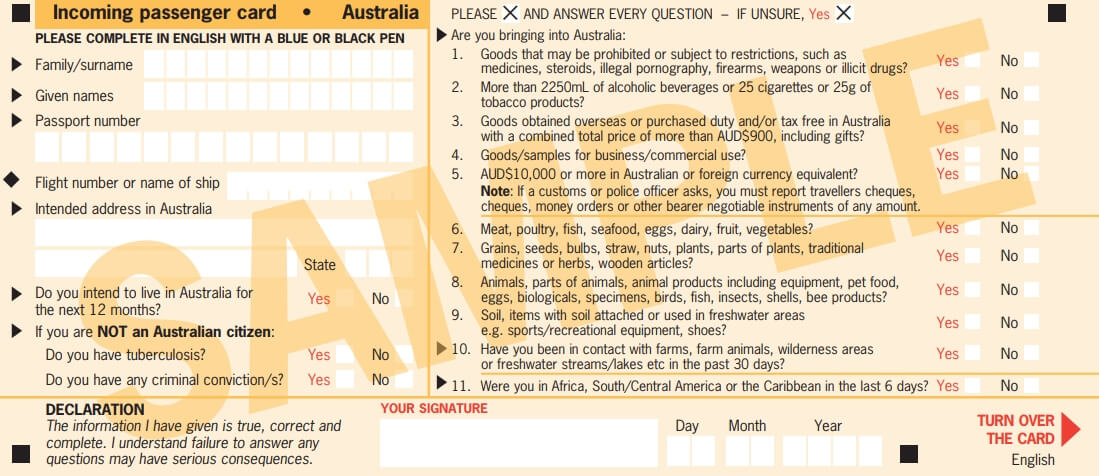
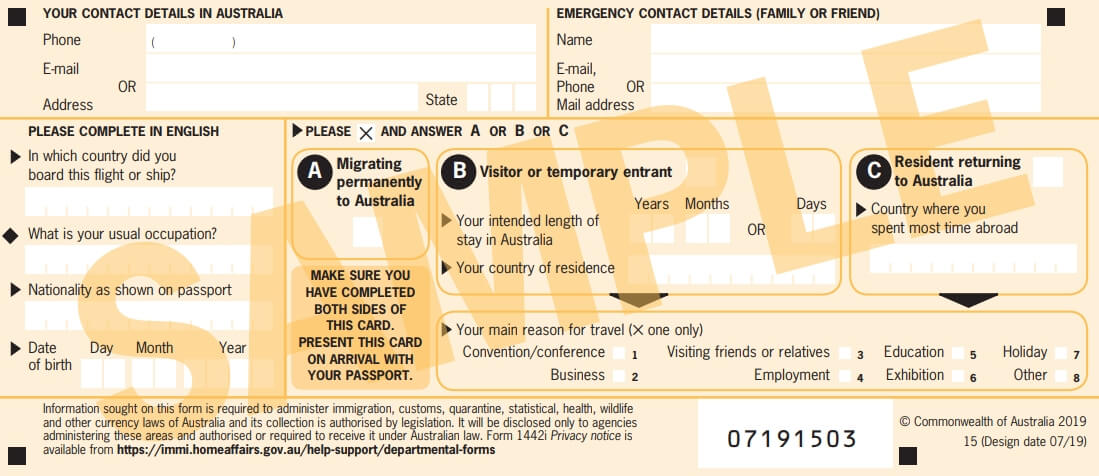
(Image source / Australia Government official website)
Chinese version of the Australia Incoming Passenger Card:

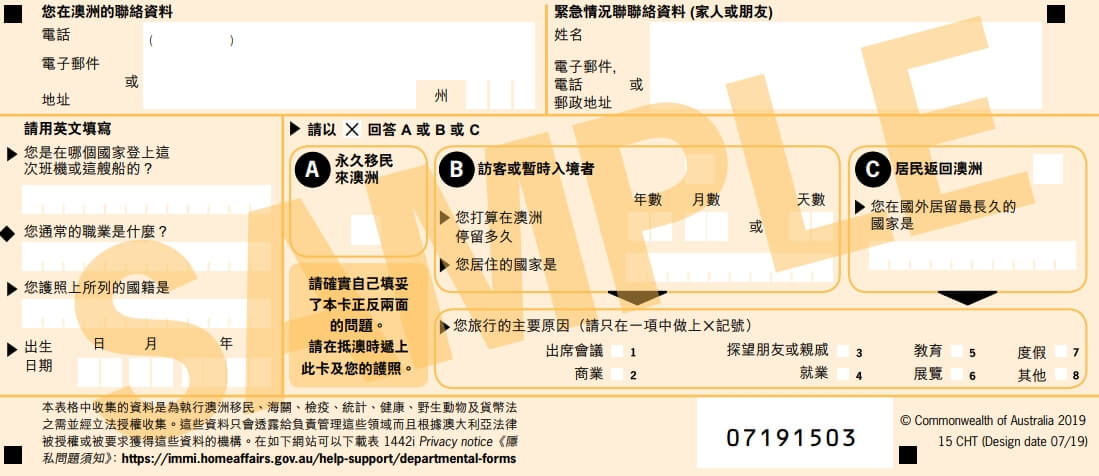
(Image source / Australia Government official website)
📢 Reminder: This Chinese version is only a template. Generally, the version distributed by flight attendants is in English. If you are worried about not understanding the English version, it is recommended to screenshot the Chinese version in advance for comparison.
Checkpoint 2: Immigration Inspection
Australia's immigration inspection is divided into two types: manual and automated customs clearance. You can choose the most suitable customs clearance channel according to your personal needs.
Manual Customs Clearance
- Preparation: Be sure to have your passport, visa, and fully completed incoming passenger card ready.
- Customs Questions: Customs officers usually ask questions about the purpose of entry, length of stay, and family/friend relationships, etc.
If you are not familiar with English, you can request free translation services at the airport for assistance.
Automated Customs Clearance
- Required Documents: Have your passport, visa, and fully completed incoming passenger card ready.
- Find Equipment: Locate the automated customs clearance kiosks in the arrival hall.
- Select Language: Choose a suitable language interface.
- Insert Passport: Insert your passport into the designated slot.
- Fill in Information: Follow the on-screen instructions to fill in the information.
- Obtain Clearance Card: The kiosk will print out a fast-track clearance card.
- Biometric Identification: Proceed to the Smart Gates, insert the clearance card into the machine, and complete facial recognition as instructed.
- Completion of Clearance: After successful verification, you can pass through customs smoothly.
Checkpoint 3: Customs Inspection and Quarantine
Customs inspection is the last checkpoint and also the most challenging one when entering Australia. To facilitate passenger clearance, Australia has set up red and green channels.
🔴 Red Channel
For passengers carrying items that need to be declared, such as food, plants, animal products, cash exceeding the specified amount, etc. Customs officers will conduct a detailed inspection of these passengers' luggage to ensure that no prohibited items are brought into the country.
🟢 Green Channel
For passengers with no items to declare. Through a simple luggage X-ray scan, it is confirmed that the passenger is not carrying prohibited items.
IV. What items are prohibited or allowed to enter Australia? How much cash needs to be declared?
(1) What food items are not allowed to enter Australia? List of prohibited and restricted foods
By now, you may be wondering exactly which items are prohibited from entering Australia and which items need to be declared in advance. Let's analyze them one by one.
Australia Restricted Import Items
| Category of Items | Description |
| Egg products | Fresh eggs, salted eggs, preserved eggs, etc., as well as egg-containing foods such as egg yolk pastries, mayonnaise, and rice dumplings with eggs. |
| Dairy products | All foods containing more than 10% dairy products, such as instant milk tea or ready-to-eat cereal foods with added milk ingredients. <br> If traveling with an infant, infant formula and dairy products from New Zealand are allowed. |
| Non-canned meat products | All animal meats, whether fresh, dried, frozen, cooked, smoked, salted, pickled, or packaged. |
| Live animals | Live mammals, birds, fish, reptiles, amphibians, invertebrates, etc. |
| Live plants | Various potted plants, cuttings, including seeds, bulbs, tubers, etc. |
| Herbal medicines and traditional medicines | Bird's nest, cordyceps sinensis, ganoderma lucidum, etc., as well as deer products such as antler, deer horn, and deer glue (excluding deer products from New Zealand). |
| Seeds and nuts | Popcorn, raw peanuts, chestnuts (excluding New Zealand chestnuts), and other dried fruits containing seeds, such as handicrafts or souvenirs. |
| Fruits and vegetables | All fresh and frozen fruits and vegetables. |
| Weapons and ammunition | All weapons and ammunition. |
| Others | Any type of drugs (such as marijuana, heroin, cocaine, etc.), counterfeit or pirated goods (such as DVDs, clothing), illegal obscene items (such as child pornography |
Items Allowed into Australia but Requiring Declaration
| Category of Items | Description |
| Meat products | All meat products, including beef, pork, lamb, chicken, etc. |
| Fruits and vegetables | Dried fruits and vegetables (such as Hericium erinaceus, dried longan, dried lychee, dried tangerine peel, preserved plum), etc. |
| Processed foods | Packaged meals, noodles, rice, snacks (such as ginkgo nuts, peanuts, dried meat floss, biscuits). |
| Beverages | Coffee, tea, and beverages containing milk. |
| Seasonings | Various seasonings, such as soy sauce, chili powder, curry powder, fennel, cinnamon, etc. |
| Animal products | Processed clean feathers, bones, ivory, animal heads, leather, and furs, etc. |
| Plant materials | Wooden handicrafts, carved objects, dried flowers or dried flower decorations, etc. |
| Medicines | Medicines containing ingredients such as steroids, opium, marijuana, etc. Common over-the-counter drugs (such as aspirin) and prescription drugs for personal use with a quantity not exceeding a 3-month supply usually do not need to be declared if an English prescription certificate issued by a doctor can be provided. |
| Others | Used sports or camping equipment, such as bicycles, fishing gear, tents, etc., as well as medicines like human growth hormone, DHEA, and androgens. |
Items Allowed into Australia Without Declaration
| Category of Items | Description |
| Snacks | Chocolate and candies (such as gummies, toffees, hard candies, mints, marshmallows, and liquorice) |
| Roasted coffee | Roasted coffee beans or ground coffee (excluding kopi luwak) |
| Tea (black tea and green tea) | Plain black tea or green tea, or those with added spices. |
| Fruit juices and soft drinks | Sealed packaged fruit or vegetable juices that do not require refrigeration. |
| Sauces | Nutella (chocolate spread), peanut butter, maple syrup, golden syrup, treacle, etc. |
| Cosmetics | Commercially mass-produced and packaged cosmetic products. |
(2) Bonus content! A list of precautions for entering Australia
In addition to the items mentioned above, special attention should also be paid if you are carrying cash or tobacco products.
| Item | Precautions |
| Cash declaration | If you are carrying 10,000 Australia dollars or more, or the equivalent amount in foreign currency, you must declare it to the customs. |
| tobacco products | Each person is limited to carrying 25 cigarettes or 25 grams of tobacco products. |
| alcoholic beverages | Passengers aged 18 and over may carry up to 2.25 litres of alcoholic beverages duty free. |
| Duty free items | Passengers under the age of 18 may carry duty-free items with a total value not exceeding 450 Australia dollars. |
The above information is for reference only. To avoid delays in your journey or legal penalties due to carrying prohibited items or failing to declare items, it is recommended that you read the official website of the Australia Government in detail before departure or consult a professional agency to obtain the latest and most complete entry information.
V. Applying for an Australia ETA is super easy! Let the agency help you enjoy Australia hassle free!
After learning about the items that cannot be brought into Australia, you can start preparing to apply for an Australia visa! We recommend choosing ETA, which has a simple application method and is the most mainstream option.
Now, you can easily complete all procedures by opening the application website: https://www.etavisa.com.hk/,without worrying about tedious application processes!
- Convenient application: No restrictions on time and location, making the application easy and fast.
- Information security: The website ensures the security of your personal data, so you don't have to worry about information leakage.
- Simple operation: The interface is intuitively designed, so even those without computer experience can easily get started.
- Instant notification: The application result will be notified immediately, allowing you to keep track of the progress at any time.
Although applying for ETA by yourself is convenient, if you have doubts about the application process or want to ensure everything goes smoothly, Nexus Travel also provides professional agency services to help you obtain ETA quickly.
- Rich experience, professional and reliable: We have rich experience in Australia visa applications, ensuring that every visa application is accurate and error free.
- One-on-one customized service: We provide personalized visa solutions for each customer to meet your specific needs.
- High success rate, trustworthy: Over the years, we have successfully helped countless customers obtain Australia visa, accumulating rich practical experience.
- Officially recognized: Our electronic visa system has been approved by the Australia Consulate, enabling us to provide you with professional and reliable visa agency services.
Nexus Travel is your best choice for fast and easy Australia visa processing!